
 Update: No More SAT Subject TestsIn January 2021, the College Board announced it will no longer offer SAT Subject Tests in the United States, effective immediately. Learn how the changes to the SAT Subject Tests will affect students. Our original post on the SAT Subject Tests is below. You have questions—we have the answers.
One of the lesser known parts of the college admissions application puzzle are SAT Subject Tests. Because of the nebulous requirements for these college entrance exams at many schools, we often get asked what these tests are and if students need to worry about them for their applications. Our answer: if you are applying to top-tier schools, most will want you to submit some combination of SAT Subject Tests, but only MIT still requires these tests to apply. For most other schools, the test scores can serve as an independent validation that your good grades in a subject were earned in a comprehensive course.
0 Comments
 Have you ever considered getting a tutor for your student? Our subject tutoring clients come to us from all parts of Montgomery County for many different reasons and represent all grade levels and academic aspirations. While the perception of tutoring is often narrowly focused on students who might have always struggled with school, the truth is that most students will need assistance to maintain or excel at their studies during their academic career.
Here are some scenarios we encounter where students benefit from academic tutoring:  You have questions—we have the answers.
As students plan their course schedule for the 2020-2021 school year, many parents and students are asking if they should take advance placement courses instead of honors or standard selections.  Montgomery County Public School students have two opportunities to take the official SAT in March thanks to MCPS’s implementation of a 2013 Maryland law.
Students considering an SAT test track this spring should take advantage of this opportunity to get twice the testing with just one course of SAT prep. Students on an ACT track can also take advantage of the opportunity, but in a different way.  You have questions—we have the answers.
With the October 2019 announcement from ACT about changes in scoring options for the test starting next school year, our parents have been asking if their students should delay taking the ACT until the fall.  By this time next year, you will be putting the finishing touches on a year of hard work, exploration, and self-discovery unlike anything you may do again in your lifetime. Daunting, yes, but remember: it’s a marathon, not a sprint. You have been preparing for this coming year for more than a decade, and if you stay on track and follow some simple guidelines along the way, you will conquer the college admissions process in one piece and position yourself for future academic success at any number of schools.
At the highest level, your plan should include some key components for academics, testing and prep, and school research and selection. Each will be a facet of the college applications you will submit next year. Here is our roadmap for how to break the process up into manageable chunks and which components to tackle as the year progresses.  Should you take the SAT or the ACT? Do you know? Are you or members of your family test biased?
It’s okay – this is one “dogma” of the college admissions process that has been hard to break through. But the truth is – either test will work for your application, but either test might not work for you  You have questions — we have the answers.
Today we will tackle Score Choice for the SAT and ACT tests. We often get asked by parents of Seniors if the schools their children are applying to can see all of the scores for the SAT or ACT tests the student has taken.  Are You Ready to Tackle the High School Admissions Process?The school year just started, but if you are an eighth grader, it is already time to consider where you will be attending school this time next year as the high school admissions process has kicked off at most schools.
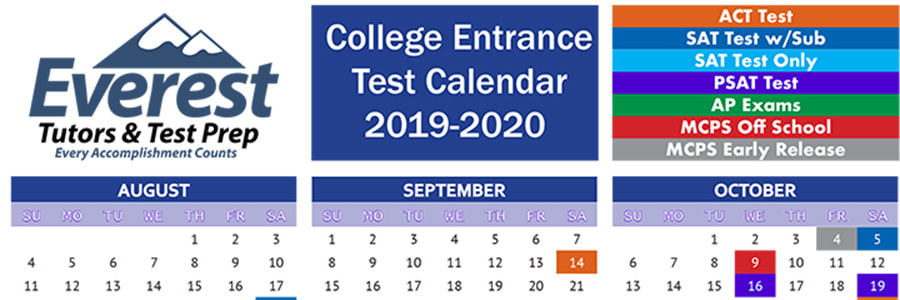 If you are planning on taking an SAT test, ACT test, PSAT test, or AP exams this school year, we have something for you. Our handy test calendar allows you to track these important dates, the days Montgomery County Public Schools will be off or have early dismissal during the 2019-2020 school year, and the key to dos for students planning their college admissions process.
|
AuthorAnn Derryberry Archives
March 2024
Categories
All
|
 RSS Feed
Telephone |
© 2024 Everest Tutors & Test Prep | All Rights Reserved